What do you need to start forex trading as a complete beginner?
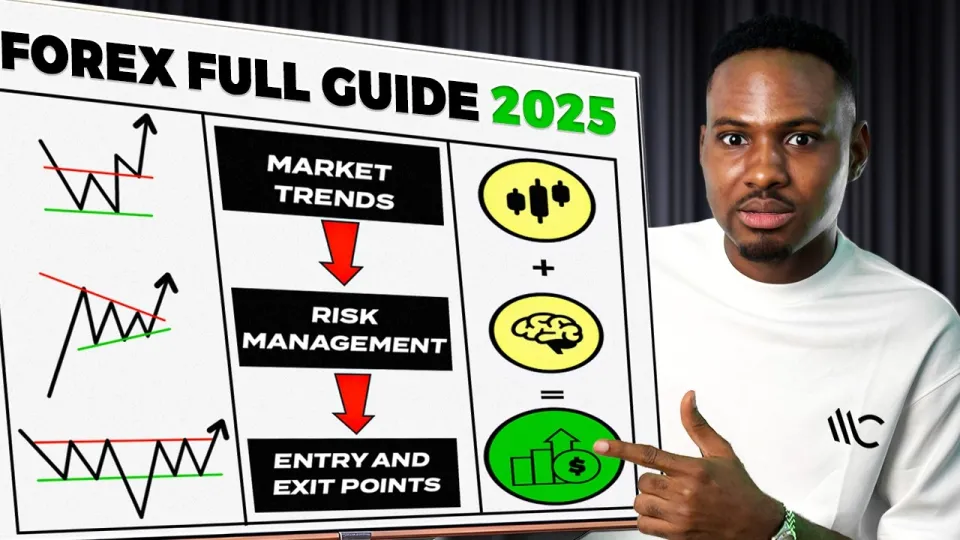
Video: How To Start Forex Trading For Beginners’ 2025 (Full Course)
Need articles like this for your video? They help promote it on YouTube and Google — order them in the Telegram bot @sat_sit_bot. The bot writes and publishes the articles itself (with your YouTube video embedded) on popular topical websites (no ads). Your first 50 articles are free.
· based on the channel Jeffrey Benson Forex
Key takeaways
- Forex is an over-the-counter market where currencies are quoted in pairs such as EUR/USD, and retail traders speculate on price changes rather than taking delivery of currency.
- The market runs 24 hours a day, five days a week, split into four sessions: Sydney, Tokyo, London and New York, with London–New York overlap producing the deepest liquidity.
- A beginner's minimum toolkit is a demo account, a charting platform such as MetaTrader 5, a broker with regulated segregation of client funds, and a written trading plan.
- Risk management comes before strategy: professionals commonly risk 0.5–2% of account equity per trade and size positions in lots (1 standard lot = 100,000 units of base currency).
- Most beginner losses trace back to overleveraging, trading without a stop-loss, revenge trading after a loss and skipping a trading journal.
Forex trading for beginners means learning one narrow skill set before risking real money: understanding how currency pairs are quoted, opening a demo account with a regulated broker, sizing every position so a single loss stays small, and only then placing a first trade with a documented plan. The full beginner course published by Jeffrey Benson Forex walks through exactly that sequence, and the author's student programme is available at Fire Pips FX plans.
What forex trading actually is and how currency pairs are quoted
Forex is the global market where one currency is priced in another, and every retail trade is a speculation on the exchange rate of a pair rather than a purchase of cash. Currencies are always quoted in pairs: the first currency is the base, the second is the quote, so EUR/USD at 1.0850 means one euro buys 1.0850 US dollars. A long position profits when the base currency strengthens; a short position profits when it weakens.
The most traded pairs are EUR/USD, USD/JPY, GBP/USD and USD/CHF, and beginners are usually steered toward them because spreads are tightest and liquidity is deepest. Prices move in increments called pips — for most pairs a pip is the fourth decimal place, while JPY pairs use the second decimal. Position size is measured in lots: a standard lot is 100,000 units of the base currency, a mini lot is 10,000 and a micro lot is 1,000, which is why micro lots matter for small accounts.
How the forex market works across sessions and leverage
Forex is an over-the-counter market with no central exchange, so brokers quote prices and route orders through liquidity providers, and the market is open around the clock from Monday to Friday. Trading activity rotates through four sessions — Sydney, Tokyo, London and New York — and the London–New York overlap is generally the most liquid window, with tighter spreads and cleaner moves than the quiet Asian afternoon.
Leverage is the feature that makes forex accessible and dangerous at the same time. A broker offering 1:100 lets a trader control a $100,000 position with $1,000 of margin, which magnifies both gains and losses; a 1% adverse move on that position wipes out the entire margin. Spreads, commissions and overnight swap charges are the real costs of trading, and they compound quickly for anyone who trades several times a day.
The tools and accounts every beginner needs before the first trade
A beginner needs four things working together: a regulated broker account, a charting platform, a demo environment and a written plan. Setting them up in order avoids the most common early mistake of funding an account before knowing how to place a stop-loss.
- Choose a broker regulated by a recognised authority, with segregated client funds and a demo account that mirrors live conditions. The course author recommends Assex Markets and provides a registration link: https://my.assexmarkets.com/auth/register?partner_code=1699134
- Install MetaTrader 5 (or an equivalent platform) and connect it to the broker account; MT5 gives candlestick charts, indicators, one-click order entry and a strategy tester.
- Practise on demo for a minimum of one to three months, logging every trade until the process — entry, stop, target, position size — becomes routine.
- Build a trading journal from day one: pair, session, setup, risk in percent, result and a one-line note on execution quality.
Building a basic forex strategy foundation
A workable beginner strategy is a rule set for when to enter, where to place the stop and where to take profit, and it should be simple enough to execute the same way fifty times. Most starter frameworks combine a market structure read (higher highs and higher lows versus lower highs and lower lows) with one or two tools — support and resistance zones, a moving average, or a session-based time filter.
A practical template looks like this: trade only during the London or New York session, wait for price to reach a pre-marked level, require confirmation such as a rejection candle or a break and retest, place the stop beyond the structure that invalidates the idea, and target at least 1.5 to 2 times the risk. Writing the rules down and backtesting them over several months of charts is what separates a strategy from a hunch; without that record there is no way to know whether the edge is real or the result of a lucky week.
Placing a first trade and sizing risk correctly
Risk management is the part of forex that decides whether a beginner survives long enough to become consistent, and it is applied before the entry, not after. The standard rule is to risk a fixed small percentage of equity per trade — commonly 0.5% to 2% — and to calculate lot size from that number, the stop distance in pips and the pip value, rather than picking a lot size first.
For example, on a $1,000 account risking 1% ($10) with a 20-pip stop on EUR/USD, where a micro lot is worth about $0.10 per pip, the position works out to roughly 0.05 lots. The trade is then placed with the stop-loss and take-profit attached at entry, never added afterwards. A first live trade should be the smallest size the broker allows, taken on a setup already traded on demo, so that emotion stays out of the execution.
Common beginner mistakes and the questions traders keep asking
Most beginner accounts fail for behavioural reasons rather than analytical ones, and the recurring themes in the comments under the course are telling: people ask whether they can start with a small balance, how long before going live, and why risk management finally made sense after months of confusion. The answers are consistent — start on demo, size down, and treat the first year as tuition rather than income.
The most expensive mistakes are overleveraging a small account to chase fast returns, trading without a stop-loss because the position is 'sure' to come back, revenge trading immediately after a loss, jumping between strategies every week, and ignoring news releases such as central bank decisions and US payrolls that spike volatility and widen spreads. A trader who journals every trade and reviews the log weekly will spot these patterns in their own data faster than any mentor can point them out.
Useful links from the course
- Fire Pips FX student plans — the author's paid mentorship and course tiers.
- https://t.me/firepipsignals — one free trade idea posted daily.
- https://my.assexmarkets.com/auth/register?partner_code=1699134 — broker registration used in the course.
- https://t.me/jeffreybenzhelpbot — entry point to the premium signal group.
The realistic path from first demo trade to consistent execution
Forex rewards process discipline far more than prediction, and the beginner who spends the first months on a demo account, a fixed risk percentage and a written journal is building the only foundation that scales. The course from Jeffrey Benson Forex is structured exactly around that progression — what the market is, how it operates, which tools to install, how to build a simple strategy and how to size a first trade — and it is a sensible starting point for anyone serious about learning properly. Before committing capital, review the student options at Fire Pips FX plans, and treat any signal service as a supplement to your own tested rules, never a replacement for them.
Questions & answers
How much money do I need to start forex trading?
You can open a live account with as little as $50–$100 at many brokers, but the amount matters less than position sizing. With a small balance, trade micro lots and risk no more than 1% per trade so a normal losing streak does not end the account. Many beginners spend one to three months on demo first, which costs nothing.
How long does it take to become profitable in forex?
There is no fixed timeline, but most consistent traders describe a learning period of one to three years that includes demo practice, a small live account and a detailed journal. Profitability comes from repeating one tested setup with controlled risk, not from finding a secret indicator. Anyone promising fast returns is selling something other than skill.
Do I need a large broker or can I use any platform?
Prioritise regulation, segregated client funds and reliable execution over bonuses or tight-spread marketing. MetaTrader 5 is the most common platform for beginners because it offers charts, order management and backtesting in one place. Test the broker's demo first and compare spreads during the London–New York overlap, when real trading costs show up.
Is copy trading or following signals a good way to start?
Signals and copy trading can shorten the learning curve only if you already understand risk, because you still control lot size and account exposure. Use free signal channels to study how setups are framed, not as a substitute for your own rules. Copying trades blindly means you inherit someone else's risk tolerance, which rarely matches your own.
Source: How To Start Forex Trading For Beginners’ 2025 (Full Course) · Markdown version